Showing posts with label Training. Show all posts

Tuesday, January 5

I'm back among the living!

Wishing you and yours a great, safe 2010!

Whew! Where did the time go?! I'm glad the old is over and the new is underway. I know it's a cliche, but the new year always brings new hope and inspiration. Like many others, I had a challenging year, but I am still breathing. The key to a stressless holiday, IMHO, is to avoid all stores. If I couldn't make the gift or purchase it online--it just didn't get gotten! (excuse poor grammar).

(The anguish on the face of these figures in Lorado Taft's "Fountain of Time" is exactly how I felt a few days before Christmas, click for closer look)

I think I've taken my last ride of the season (sigh). This decision has nothing to do with the cold weather that has gripped Chicago. In fact, on my last ride, which started off around 20 degrees F with a high that day of 24, was quite comfortable. My Tourmaster electrics are great. I dressed so well that I felt a bit too warm when I reached my destination. By the time I returned home and disrobed, I was sweating. Even the black ice that my back tires greeted didn't factor into my decision to end my ride season. No, I realize that the numerous must-do tasks that I procrastinate with during the summer, need to winter to resolve. Trying to also fit in riding is contrary to my "seek balance" and "let go" philosophy I've been trying to implement. I live in an environment that makes winter riding a challenge that I choose not to fit in this winter. (Big sigh)

Right now things are out of whack and I need to shift gears, so to speak. Besides, it's long winter evenings slurping down Japanese Sencha or various Oolong teas, while pouring over maps and tossing around trip ideas I fantasy for the new ride season that gets me through the winter doldrums. It is also the time that I re-read motorcycle classics and catch up on magazine articles on riding technique and safety. The last great book I read is Riding in the Zone: Advanced techniques for skillful motorcycling, by Ken Condon, a protege of David Hough. I've read it once and will re-read it before the start of spring. It's a must-read book for all two wheel travelers.

(Looks like a nice spring, summer or fall day, doesn't it? It was below freezing-fun!)

(LOOK where you want to go!)

When I saw this family out for an afternoon of ice skating, I thought of the motorcycle safety class axiom: look where you want to go. This family went down often that night. I wanted to yell to them to look ahead, look up, look anywhere but down, but I didn't. I just smiled at their family fun and tripped the shutter to capture images of one or more of them prostrate on the ice. I could relate. On my last ride, I found myself having to look at the ground more than I know is good. Mostly, one can scan the ground now and again to look for changes in the color or surface but one doesn't want to lock the eyes there. I must confess, I did some eye-locking on the last ride because those deceivingly small patches of ice that blended so well with the road surface caught me by surprise a few times. The longer I rode the better I was at winter scanning of seemingly clear roads, which is a bit different than summer scanning...imho.

(Seen on a power walk morning).

Physical issues that I plan to correct before the spring. I've read that despite my painful back, I should still do the weight lifting. I slowed down and stopped completely when my back became chronically inflammed. I've missed weight lifting but the back was giving me so much trouble that I thought I should lay off. But I'm convinced that when I was lifting--seriously lifting--my back seemed to breakdown less. Yes, "the old gray mare ain't what she used to be" but I'm not dead yet! I won't go down without a fight! Riding a motorcycle well--at least the way I want to continue to ride--requires excellent fitness. I believe that the older I get the more I need to rely on smart strategies and techniques to do what I used to do without thought.

Now, it's training most wisely. It is now better for me to do 25-30 miles a week of jogging than 60 miles a week of running/training, which I used to do a couple of decades ago. My knees and back now prefer long power walks, robust hiking, and inline skating over a ten miles early morning run. But even my "preferred" outlets were taking a toll on my back. My F800ST is a perfect bike for me because the slight forward position (which I actually uprighted a bit) keep the pressure off my tail bone. My Suzuki SV650 was perfect in every way except that after a 600 miles day, I felt it. This is not the case on the ST. I plan to keep up the long distance riding and there is a direct positive correlation with fitness and miles (IMHO). At least, that's true for me. My last Saddle Sore was a breeze compared to the first one. A fit body can handle more stress. Period. So this winter, I'm back to becoming one with free weights.

(I will miss Jesse Owens, my motorcycle--but heck, it's only for a few fly-by months)

So, this blog will, for the next three months morph into riding news, book and gear reviews an occasional rants about something motorcycle related (like that essay I've been working on about solo riding). This will also be the place I toy with some trip ideas and might even solicit some ideas from you. I have a motorcycle related project in the early stages that will help those living in a poor country. When the details are worked out, I will share it with you 'cause I'm hoping you might want to offer your two cents.

(The picture is of the City Auto Pound, situated on the lowest level of Chicago (the City's underbelly). It's where unluck illegally parked cars wind up. The area also provides a short cut through much of the downtown area. I motorcycle often in and out of this space).

Until next time...happy riding if you're still riding the asphalt. And if you're tucked away your ride partner for the winter, remember: "This too shall pass."

Wednesday, August 12

My first Track Day!

Three events have converged nicely to hone my riding skills. First, on July 26, I took an advanced street riding strategies class that stressed better braking, proper cornering and entry speed, and using lower body action to become a maximally efficient rider. Second, about a week later I came across an excellent book, Riding in the Zone: Advanced Techniques for Skilled Motorcycling, that I’m planning to review soon. Third, I was approached to participate in my first Track Day (TD) event.

I had planned to do a TD before the end of this ride season. Then on Saturday, while in Motoworks to retrieve my SV650, I ran into Johnny, the owner who asked me when I was going to participate in their TD. I said I wanted to and had planned to—sort of. This has been my response now for several years. He asked what I was doing Sunday, the next day. Actually, work had made me cancel my trip, so I was relatively free(er). He sprang it on me that the Motoworks sponsored TD would commence with a Sunday dinner gathering at Gingerman Raceway on Monday in South Haven, MI. Although caught a bit off guard, it didn’t take much to convince me that it was time to do Johnny's TD. I had one tentatively scheduled for September at the Autobahn in Joliet--but what the heck…

Had a nice, hot and sweaty ride up to South Haven on Sunday. Only the last 30 minutes of the less than 2 hours ride turned dark and rainy with an added benefit of a cooling wind. The dinner at Clementine’s was a chance to see familiar faces (the Motoworks staff) and meet a few new ones. “Thanks” to Johnny for picking up the dinner tab for the whole group.

Monday, 7:30 a.m. check in at Gingerman Raceway. The day began with registration, high energy snacks, bike prep and inspection, and track staff introductions. The event was taught by the folks at Sportbiketracktime.com. The instructors all seemed highly skilled and unquestionably competent. They were an engaging bunch and full of clear and easy to instructions to share. I was impressed with how accessible the instructors were. I appreciated that they emphasized safety above all else and underscored that the tone of the day was not about racing but about improving one’s skills at cornering and its related components. After introductions and spelling out the rules of the day we were ready to roll.

(Beemers were out in full force)

We were separated into groups by skill level. One of the neat things about this TD was that it was low keyed and non-competitive. About half of the participants were new, either never having done a TD or having only one under their belt. This made for a dynamic group, in my opinion. All told, there were around 50 riders with half being “advanced” TD riders and the other group consisting of varying levels of “Novice.”

Prepping the bike is quite interesting. Everything that could send a signal to the rider and those around him or her gets taped. This includes all lights, speedo and tach. Initially this seems rather extreme but soon the “why” becomes clear. One doesn’t need distractions on the track. Moreover, not having this information forces one to rely more on the brain and other sensory cues. Deflating the tires to 30lbs also made sense in that doing so increases the tire contact patch, which puts more rubber on the road.

Classroom meetings: Each ride session was approximately 30 minutes followed by a classroom meeting. In class, we listened and learned things about the track, heard strategies for maintaining clean lines, and asked for assistance on specific track challenges. We learned about tricky corners and how to enter and exit them; we even heard a bit of physics on how bikes behave when leaned, when given more or less throttle and how body action works for or against one’s efforts. Bright orange cones, located throughout the track were demystified and explained as more than place holders but as valuable pointers for executing turn-in and noting an apex; we learned to use visual cues as aids in honing our developing cornering skills.

The Track layout: We began by following our instructor, whom we shadowed on the inner line, the outer line, and then the race line of the track. Each line requires an adjustment on how good cornering is accomplished. I found some of my pre-lunch runs better than some of the later ones. Adrenaline might be the reason. I had made goals the night before that this was going to be about my own improvement. Nothing more. Nothing less. I will never be the fastest rider on the road. It’s not a goal I covet. I do, however, want to be highly skilled and competent on the road, to be in control no matter the road challenges I’m likely to encounter. So, I happily settled in or near the back of the queue for my group.

The track is fast—or so it seemed to me. The ground, which I should not have been looking at, whizzed by at shockingly extreme speed, which was mostly mental as I never got out of third gear—but I never ran in third gear THAT fast and THAT hard before! Regardless of the actual gear the bike was in, we were moving FAST!  The speed definitely required one’s full concentration as the track’s challenges were inspiring, surprising (at times) and ongoing. Getting lazy in any one area could lead to trouble down the road, so to speak. Although the 30 minutes time slots on the track always seemed to fly by, being in the zone, in such an intense way demanded huge chunks of physical and mental energy. Remaining focused, hydrated and responsive on such a hot day, added to the TD demands.

On the track, some turns/corners seemed effortless but it was not something one could count on. One easy corner turned out to be a tricky set up for the more challenging ones down the track. I learned early on that the corners could never be taken in isolation. One had to consider the track as a whole. Corners are linked in that how one enters one corner can make or break the next. In other words, it was necessary to set up properly for corner "A", because it could determine how one handled corner "B" and so on. That’s not to say one can't make corrections. But it does say that it’s easier to do the cornering correctly so that the road doesn’t become one big struggle to survive each turn. The only way to deal with this well is to ALWAYS be looking ahead, always be aware of what is coming up on the road so that you can set yourself up properly. For those blind corners, well, if you're in the correct position on the track/road, you can even handle these blind corners well by being in a good lane position to act swiftly when you finally can see around that corner. Constant scanning is exhausting work as is being on high-alert every minute of a ride.

(Some of Motoworks' staff)

One of the biggest lessons I learned was trusting my bike to execute my input. As someone with a huge investment in my brain, I tend to deliberate before I’m willing to commit to an action. Motorcycling often requires quick judgment. Yet, some things seems counterintuitive. Like counter steering. In the early days of learning to ride, counter steering seemed (b)ass (a)ackwards. Now, I can’t imagine why that concept once gave me pause. On TD, I realized that while I have no problems leaning, I was not as quick to roll through all corners—particularly at the more extreme lean angles--I was conservative at best. The thought of giving it more throttle at such times seemed crazy. I learned that this inability almost always meant that I had entered the corner too fast to begin with! The bike behaves better when one can enter the corner a tad slower, start the lean and roll completely through.  On baby, moderate speed corners this was a non-issue. But on faster corners, that came at me in a flash, and required sharper leans even a split second of hesitance is not good. I began trying to decidedly and consistently roll through each corner, more and more, and by the afternoon, I got it. This is huge for me. I thought of my Suzuki SV650 with its light weight and high fun factor and realized that it would be a perfect TD bike. I made a mental note to use it next time. I must admit, I had to shake off thoughts of damaging my ST. Perhaps that’s good for it kept my focus totally on the task a hand, so much so that I think I gave myself a headache by the afternoon.

I marveled at the advanced group. I saw people dragging their knees. I saw people who looked like they were sitting on the side of their bike they were hanging that far off the seat. I’m not sure I ever what to join their ranks but I leaned farther that day than ever before on my bike and I am confident in trusting it to respond to inputs from my throttle, handlebar and body shifts.

Throughout the day, the classroom continued to be a place of wise instruction and check in on the track experience. I asked a question about turning wide in one particular corner. The instructor told me what to do, he stressed being aware of my cornering line. The outside-inside-outside we learn during early motorcycle instruction, works in many circumstances. But one can’t apply that to every corner. I had been using the cone as the point at which I executed my turn in but consistently was going wide in the same corner. He told me to watch my entry. Am I turning in too early or too late? Am I leaning too much? He suggested I follow a delayed apex line, that I should travel a little pass the cone, look well into the corner and quickly execute the turn in. It was the quick, deliberate execution of the turn in that worked. All this while not focusing directly on the cone, of course. Bottom line, slow down the entry, look through the corner, commence the lean and throttle through the corner. It’s what I’ve read from other as: the slow in and fast out method.

(The Suzuki Gladius 650)

This brings up something that is powerfully examined in Ken Condon’s new book and included DVD, Riding in the Zone. In it, Condon emphasizes the importance of visual acuity, that is the ability to read the road, use one’s eyes to make a host of determinations about what is observed on the road, when to initiate one’s plan for safe riding and proper execution and knowing at all times the best lane position for conditions. Condon’s stresses that our eyes are not only for looking but for seeing, which are not necessarily synonymous.

(Holly's too cute trail bike!)

I ended my TD a little early only because I managed to acquire a headache. On my last run I found myself paying more attention to my brain drain than the track. Time to get off. I had a fabulous time, a day full of learning and getting outside my comfort zone. We improve by stretching our limits in a safe and controlled environment. As I packed up for home, I thought, “I’m impressed. I’m getting out of here without anyone asking me anything about my hair or making some ridiculous hair comment. But before I pulled off, four people separately made a hair inquiry. “Yes, it’s my real hair.” “No, it has never gotten caught in the chain--my bike doesn't have one.” “I’ve had locks for more than 10 years.” “No, they don’t take a long time to ‘braid’” 

Still, it was a special day and I’m looking forward to returning next ride season.

(Thoughtful of them to match the tape to my bike) 

I rode home that day with renewed confidence from having participated in my third rider skill building activity in weeks: an advanced street riding course, reading a new skills book, and my first Track Day. It’s all about riding with confidence and competency and an ongoing goal of increasing skills mastery. Do a TD, it stretches your riding muscles.

Wednesday, July 29

Clutchless shifting,downshifting, and trail braking: SRTT, Part 2

Now that I've had some time to consciously apply some of the skills learned and relearned in the SRTT class, I wanted to share a few more things from the SRTT advanced strategies class. Now, these skills may be old hat to the experienced riders-readers of this blog. To me, they were not new skills per se but they were skills I either don't regularly employ or need to improve.

First, is clutchless shifting.To be perfectly honest, I've done such shifting more times than I can count. But until my SRTT class, I had never done it purposefully! No, I clutchless shifted before out of error and it was something I tried to avoid doing. I recall once when doing it badly, it freaked me a tad. Not knowing what I was doing made me think I was screwing up something.

Now, I've learned how to clutchless shift and when it is appropriate to use clutchless shifting. I am now a conscious clutchless shifter. I am judicious in my use. And, before anyone thinks clutchless shifting messes up the transmission, let me tell you, you are wrong! Proper clutchless shifting does not. Improper shifting does. You pre-load the clutch, just as you would do in ordinary shifting. There is a moment, a brief moment when the engine has a space where it is perfect for snapping the shifter up (of course, you're off the throttle for that brief time) and the gear, Voila, changes quickly, smoothly and easily.

Here's when I've used it: I enter lots of fast traveling Interstates where allowing mergers in is like asking a driver to surrender a kidney. Sometimes it takes much time to get up to speed, merge smoothly and watch out for those vehicles resistant to letting you in. Traditional shifting can consume valuable micro seconds. By having one less thing to think about, that is, pulling in the clutch, one can get on with the business of getting quickly on the expressway. I love this new skill, which I've gotten really smooth at executing since the class. I see it as my method for getting on aggressive, fast moving, Interstates.

Second, is downshifting. This is a technique I consciously have always used. I've owned my share of automobiles. I've never owned an automatic transmission. I learned to properly downshift with years of handling a stick shift. I understand this technique. Bottom line, if you simply downshifted without slowing down your engine speed, it can freak out your machine, hurl your body forward, throw the back end out of line--it could upset the bike and cause rider injury. Downshifting badly in a car is no huge deal--you've got four wheels to keep you grounded. Bad downshifting on two wheels can be ugly.

If you're in fourth gear, moving at a fast clip and you need to get to first quickly you listen to your engine revs. You want to match that. You want to give the throttle enough blip--not too much and not too little. This is learned. You will blip the throttle (blipping is by definition a quick jolt to the throttle) and then downshift. You'll know if you've given it just the right amount because the bike will smoothly change to the lower gear without pulling you forward, or yanking your body backward or disturbing the back end of your bike. Just right, means the bike continues in its forward line of travel without showing signs of being disturbed. Here's what the sport riders say about it.

Third, is trail braking. Another one of those skills that I've done because it makes sense. But I didn't remember the theory behind it. Here is the theory. All I know is, it works and it gives the rider a high level of comfort in curves or when the bike is leaned over and you need to use/keep brakes applied. To know this is to increase one's comfort level when the bike is not perfectly upright. I don't ride mountain road enough to have yet feel entirely fluid. I do well, but I don't have the skills yet to blast through. I do the speed limit, perhaps 5-10 over. Now, long sweeping curves, no problem. To me, trail braking adds to the bag of strategies one can used when traveling in less than an upright position.

So, that's it. I've had some time to practice and you know what they say about practice...here's what we should say: Practice makes improvement."

Sunday, July 26

Saturday: Street Riding Technical Training (SRTT) class!

I try not to allow a season to pass without taking an advanced riding class. The only one I've ever taken is the SRTT class offered by Ride Chicago, the private motorcycle school where I re-entered the world of motorcycle riding and to whom I credit my ever-evolving skills. I've written extensively about this class before so I'll be briefer here. I don't know about the ERC given by the MSF team, but this one is superior and one I'll keep taking.

It was a gorgeous day to spend with a small group of motorcyclists. The class was small, six students (I can't remember if that includes me or not). In any case, the first thing I couldn't help notice is that the other bikes looked mean! They were bikes that made asking if they were fast, a ridiculous inquiry. They reeked speed. It showed in their hiked up tail and fierce headlights angles. For the first time, I felt my bike somewhat anemic. Jessie Owens looks downright docile standing next to those sportbikes. The riders of those aggressive looking bikes were all young men (emphasis on "young") dressed in varying styles of street bike riding jackets. One came in full leathers that reminded me of an astronaut ready to take off. One of my first thought was: I'm old enough to be the mother of every single rider here--and that includes the two instructors, Chris and Rocky! That I was the only female added to my initial sense of both bike and personal anemia.

I felt a tiny edge in that I've taken this course before and knew, more or less, what was in store. Everyone else was new to the course. The class was a half day rather than the full day program I've taken before. Still, I knew the course would be challenging, especially at first and would seem manageable at the half way point. I knew the skills that would be introduced and some are now second nature habits of my own. For example, braking. It is taught very differently than one encounters in a basic course. I can't remember the wrong way to brake anymore. In this course, braking is taught by leaving the clutch alone until the last minute. So imagine, you're riding along. You see the need to apply brakes, you do so. You apply the front and back brake in a progressive fashion. You apply pressure and then squeeze on greater presssure. Before you feel the bike chug, you then pull in the clutch. First, with this method, you're thinking of one less thing but more importantly you allow the bike to do its work easiest. It's also how racers brake and I can only say, it makes more sense and feels more logical to me.

The other huge thing one learns in this class has definitely changed my riding since first taking this class. That is, hugging/squeezing the tank as one rides and using the lower body to facilitate steering. The stress is on the lower body while the rider consciously keeps the upper body loose and light.

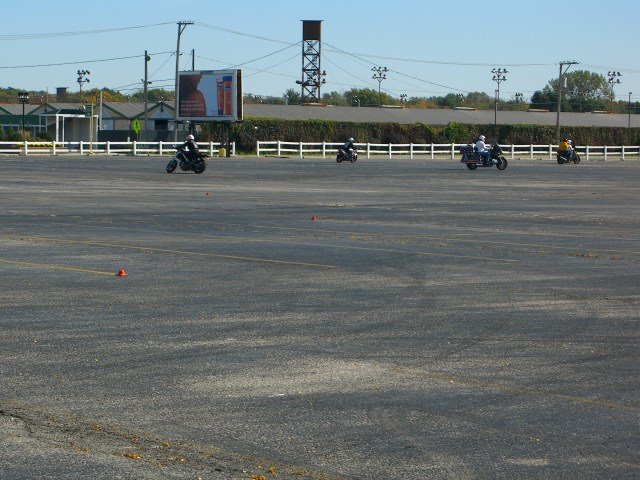
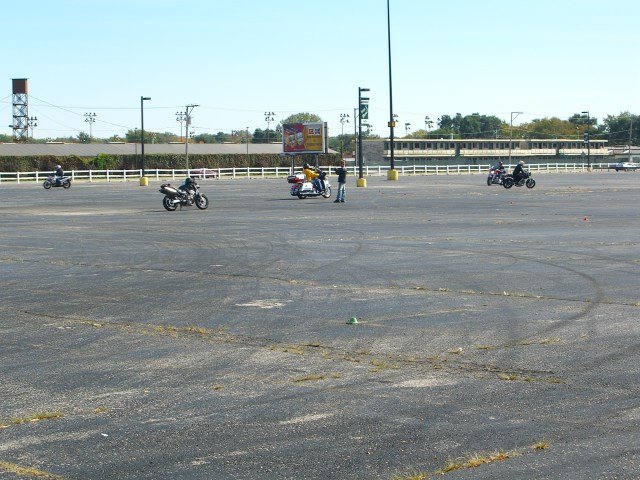
The course is a vast lot on the grounds of Toyota Park in Bridgeview, IL where the Chicago Fire holds its soccer games. The course is set up with the expected challenges of weaving, emergency braking, curves that stress entry angle that demand you slow down, look where you want to go, lean and roll through. I especially liked working on this skill. There is a rhythmic beauty to these steps. Think about it: Ride at a brisk pace toward a curve. You slow down, which can almost look like stoppingl brake before entering the curve if you must. You turn your head in the direction you want to move in, lean and roll through the curve. It's that rolling through that I enjoy. Some curves were long sweeping, some were tight and sharp. The most challenging were the multiple curves (the back to back ones) that required you to make certain that the first curve you entered you did so with spot on entry angle (the old outside inside). If not, you could (and often did) conceivably throw off all the subsequent entries! This meant making sure that you not only looked at the curve right before you, but that you also were looking way ahead, far beyond curve #1 to make sure that you, your brain and your bike are also preparing for the next curve. It reinforced what we all know or should: don't allow a road situation to surprise you; to ride well requires technical skill; look far ahead too; and, practice makes improvement.

Our first taks is to learn the course. We rode around multiple times and still I would occasional space out. I'd be concentrating so hard on the skill that my brain would suddenly switch back to reality and I'd not know where I was. I counted. This happened four times. Once it happened during the time Rocky was taking pictures/video of the class. Fortunately, I stopped and was called over by the other instructor, with whom I chatted while the gang of guys sped around the course.

The half day flew by. One highlight for me was having both instructors try out my bike. Thumbs up from both of them. I was surprised at how undramatic my bike seem when standing next to a group of overtly fast bikes. I'm not a fast rider but I do believe that in the hands of either of my instructors, Jesse Owens, my bike, could run with the best of them.

Saturday wasn't about what kind of bike one has or how good a rider one already is. It was about taking one's riding to another level--no matter where it was currently. It was about developing mastery over machine and the many road situation that exist. It was about riding efficiently and effectively. It was also about getting a glimpse of two instructors riding with skills and talents most of us can only dream about. It was interesting to see the two instructors ride students' bikes--they could hop on and ride as it they knew the bike. In reality, they know how to ride and the bike doesn't matter in the end.

The class ends with each rider completing the course while riding with one hand. Not only is this possible, it is actually rather enjoyable once you get over the fact that you'll have to make all those curves and complete the weaving with one hand! Like nothing else, one hand riding forces one to use their lower body to steer the bike. If you hadn't gotten it before, you get at this point just how important using your lower body IS--a wonderful test of how much this lesson has been internalized in the class. To manage the curves, to complete the cone weaving, and ride around the course multiple times with only the throttle hand on the bike makes you feel in control of your machine!

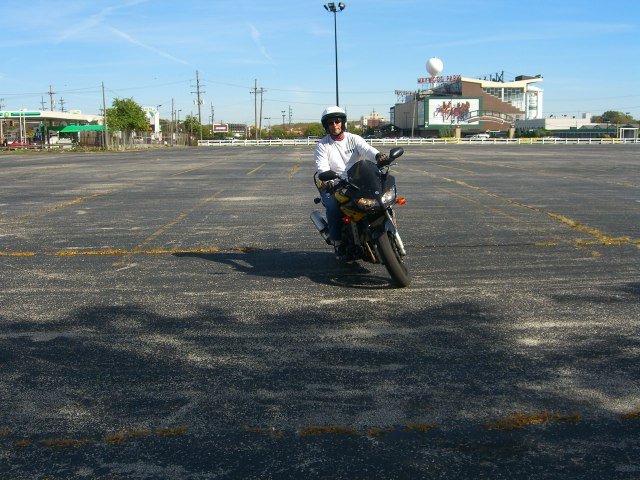
(Me and Jesse Owens!)

I don't have a lot of pictures of the day--after all the time was spent riding. It has yet to fail that after this class I always ride home a little differently, more in control, more confident, more straight up in the saddle, so to speak. It was a day well spent--even if I am old enough to be every one's mother!

Wednesday, October 25

"Look Ma, NO HANDS!"


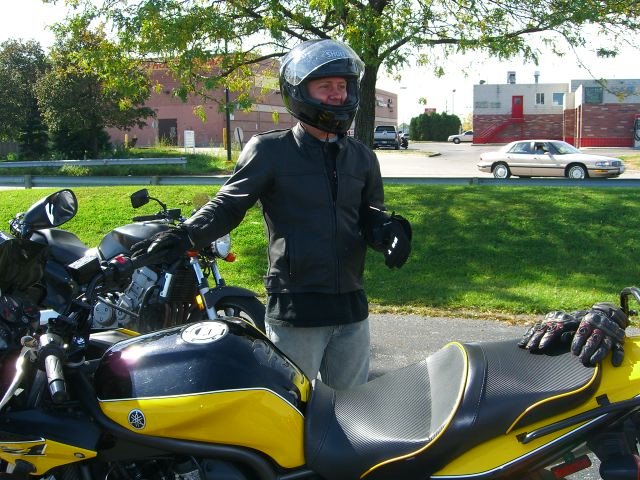
The motorcyclist in the first pic is Don H., creator, instructor of the Street Riding & Technical Training (SRTT) course I took in early October. I am thrilled I did not miss this opportunity, which I seriously might have were it not for Chris and others at Ride-Chicago, who “adjusted” my cock-eyed handlebars that were bent from the failed attempt to pilfer my motorcycle.

This is not the SRTT report I’ve been promising to post but another mini-look at some things about it. Yesterday I sent an email to a motorcyclist friend and shared with him two things we learned in the course that I’m retelling here. I’ve already written about the transforming new braking technique we learned—I swear it has made a major difference in my braking confidence. That alone is worth the course fee! But first, lest someone thinks the course was about stunt riding I need to re-emphasis that the course was foremost about safety, advanced riding skills, machine control, rider control, whole-body riding (not just riding “on” the motorcycle but “with” it), all of which leads directly to riding with more confidence.

Now that I’ve finally written the SRTT report, I realize it is far too lengthy to post and expect anyone to read and absorb. Thus, I will edit it down to more bite size morsels and post mini doses on occasion. This time, the length is not due entirely to my normal long-windedness; this time it is because I’d like the report to do justice to the fabulous things we learned over the more than six hours of instruction. But I digress…

One truly amazing thing I learned in the class was one-handed riding. Don introduced this late in the course, after we had practiced many advanced skill challenges. When I saw Don do this, I thought, I like a challenge, but this guy is finally trying to kill off the class. He expected us to do the entire range with our hand on the throttle ONLY—without using the clutch. So this is how it’s gonna end.

We mounted our bikes—a bit more tentatively than before, I must confess. With our left hand down at our side or on the tank, and keeping the bike in first gear, we rode. Straight-line riding didn’t seem difficult at all. Hmmm….But the course range is huge, really huge and marked off with miniature orange cones so that u-turns, cornering entry, figure 8s, wide sweeping curves, and sharp turns could be practiced. The course was arranged to approximate real-road situations. And this guy wanted us to do the entire range with one hand? Didn’t matter how slow we rode (thank goodness for the "Ride Like a Pro” video, where slow maneuvers are stressed). Only rule: one hand, no clutch.

Although there were eight bikes in the class, I don’t remember observing even one of them during this exercise. Mind you, they were there. I just never removed eyes from the task at hand to see how anyone else was managing. One-hand riding took ever bit of my attention and centered it entirely on riding with control. At all times, I had to think ahead. To execute the second curve correctly, I had to enter the first one on target. See, with two hands we can cheat a little, compensate for our entry errors. Come to rely on bad entry technique and cheating will catches up with you and take a chunk out of your butt! You can’t cheat with one hand.

With one hand, my head turns were earlier and precise--on point! To compensate for one hand riding, I was forced to call upon my lower half, to squeeze that tank harder than I’m accustomed to. Using my legs and thighs to move and shift my weight in the seat helps steer the bike. I know this, but do I consciously always apply it? I do now! Most important of all, one hand riding can correct bad or weak throttle control use. Think about it. There are times, rarer for me now, that I’d apply a bit too much throttle. We know what happens: you’re unprepared for the forward lurch, which on an unforgiving bike, say a Hayabusa, will kill you. Apply even a little too much and you can go zooming into outer space--or worst, into busy traffic. One hand riding demands absolute attention to smooth throttle use. I got the point, Don!

After riding around and around, the muscles in my throttle arm were crying for rest. Following hours of whole-body riding, the only part of my body that wasn’t aching was my nose. Yet, Don was no way near finished with us. I thought the one hand riding was a stunt Don was pulling on us. Turned out not to be. Don said we would now do “no-hand” riding. Ok, the one hand riding didn’t kill us; this must be his next attempt. Don, what are you, nuts? Joke’s over! What besides sure death can be gained from riding with no hands?!

Don did a no hands demonstration for us. He’s a charming fellow, very clear in his instruction, exuberant, but clearly on the nutty side if he expects us to do what we are witnessing him do. Don’s Yami FZ1 is appropriately black and yellow. As I’ve said before, he buzzes and flies around on that thing as if he’s riding a bumblebee on speed! On his bike, he reminds me of the Centaur, the half man, half horse from Greek mythology, only the motorcycle is the horse part in this case. It’s unmistakably evident that he is one with his bike. I plan to ride like that one day—assuming I survive this class.

Don rides the bike in a circle for a bit. He is talking to himself and us quietly, concentrating mostly on his bike. He’s is repeating something, almost mantra-like. It’s quiet but I think he is saying, “find you spot,” “find your spot,” all the while turning the bike in tighter and tighter circles. We focus. We watch. Eventually, the bike looks as if it is slowly spinning on an imaginary string from above. Now Don is quiet. He finds his spot and he removes both hands from the bike. I gasp. He continues his 360-degree turns with no hands; they are hanging relaxed at his sides. He just keeps going and going like a slow motion Energizer bunny. As if hypnotized, the bike spins smoothly. Then Don takes hold of the handle bars, flashes a giant grin and says something like, “that’s it, that’s what I want you to do.” Yeah, right.

Until this point, I thought Don was mostly sane, now I’m thinking he definitely inhales! The one thing I am certain about: I trust him. Everything he’s taught thus far has made an immediate improvement. Even when I haven’t fully mastered the skill, the logic and potential for improvement is unequivocal. So I cast aside suspicions of drug use and try to apply Don’s lesson. We spread out on the range so that we can “find our spot” without distraction. I head for the farthest corner possible. Again, I am not cognizant of the others in the class.
All the slow speed practice I’ve done helps in doing the slow circles—that part didn’t pose a problem. My circles got small enough to “find my spot.” But there is a great deal of psychology to riding a motorcycle. I circled, and circled, and circled. On several occasions, I lifted both hands but blink and you’d miss it. So I tried some more. Again and again and again. I will call my inability to remove my hands but for more than two seconds a minor success. I thought of one of my favorite heroes from the children’s book classic, The Little Engine that could, where the train’s lesson is to never give up. I will practice this and by next spring when I re-take the SRTT class to jumpstart the new season, I will, have found my spot, thanks to the expert tutelage of Don H.